

Key Takeaways
• Australians send approximately 20 million tonnes of waste to landfill each year, representing about 38% of total waste generated nationally.
• Organics, food scraps, garden waste, and timber make up the largest fraction of what goes to landfill, despite being fully compostable or recoverable.
• Landfill levy costs are rising across all states to discourage landfill use and fund better waste infrastructure. In NSW, the levy is among the highest in Australia.
• The National Waste Policy Action Plan 2019 targets an 80% average resource recovery rate from all waste streams by 2030, requiring significant behavioural and infrastructure change.
• Choosing a rubbish removal service that actively sorts and recycles reduces how much of your clean-out ends up in landfill. 1300 Rubbish prioritises diversion at every job.
Waste is an unfortunate fact of modern life. Many Australians are passionate about reducing their environmental impact, but aren’t sure where to start.
To understand how you can contribute to a more sustainable future, it’s important to look at the facts of waste production in Australia. We’ve compiled some of the most pivotal data points and analysed them to see where Australia’s waste problem currently stands, and how it can be fixed.
Key Takeaways
- In 2022-23, Australia produced an estimated 75.6 million tonnes of waste. This is 2.88 tonnes per capita.
- In 2018-19, 20.5 million tonnes of waste was sent to landfill.
- More positively, Australia’s resource recovery rate 2022-23 was 66%, up from 61% in 2016-17.
- Australia is well behind several targets of the 2018 National Waste Policy. Overall, a significantly greater commitment is required from government, industries and individual citizens to address waste management challenges.
What Volume of Rubbish Does Australia Produce?
- Based on the most recently available data from the 2022-23 financial year, Australia generated an estimated 75.6 million tonnes (Mt) of waste.
- This is 2.88 tonnes per capita.
- In 2018-19, 20.5 million tonnes of waste was sent to landfill.
- In 2018-19, Australia spent $17 billion on waste services, which was an 18% increase since 2016-17.
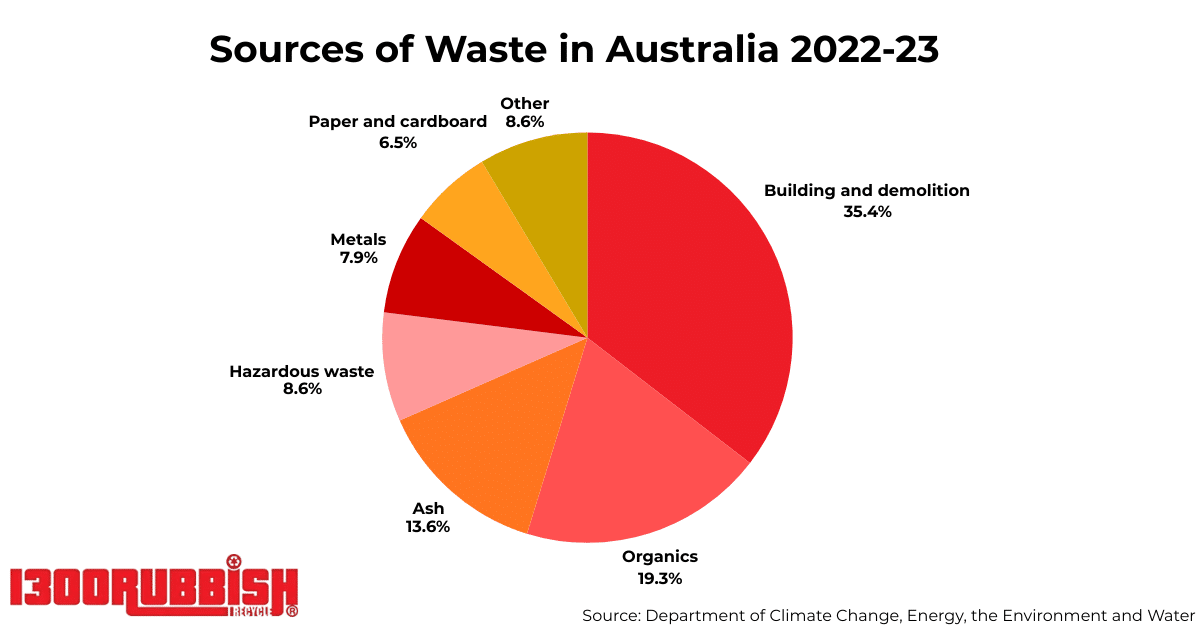
- In 2022-23, the major sources of waste were:
- 26.8 Mt of building and demolition materials.
- 14.6 Mt of organics.
- 10.3 Mt of ash.
- 6.5 Mt of hazardous waste.
- 6.0 Mt of metals.
- 4.9 Mt of paper and cardboard.
- 3.0 Mt of plastics.
How Much Waste Does Australia Produce Per Day?
In the 2022-23 financial year, Australia generated over 207,000 tonnes of waste every day.
Recycling Statistics in Australia
- The resource recovery rate in 2022-23 was 66%, meaning that 66% of the total waste generated was recycled, reused or converted to energy.
- In 2021-22, this figure was 65.3%.
- In 2020-21, this figure was 63.2%.
- In 2019-20, this figure was 62.7%.
- In 2018-19, this figure was 63.1%.
- In 2017-18, this figure was 62.7%.
- In 2016-17, this figure was 61%.
This is an encouraging increase in resource recovery and sustainability. Further improvements in this area will contribute to Australia’s circular economy, allowing for more effective national waste management.
What Are the Biggest Contributors to Australia’s Waste Production?
Australia’s waste generation comes predominantly from the following areas:
- Commercial and industrial sector: 32.9 million tonnes (44% of the total).
- Construction and demolition waste: 29.2 million tonnes (39% of the total).
- Municipal solid waste (MSW) from households and local government activities: 13.5 million tonnes (18% of the total).
What Types of Waste Does Australia Produce?
Plastic Waste
In the 2023-24 financial year:
- Australia consumed 4.0 million tonnes of plastic products and packaging. This was up from 3.9 million tonnes in 2022-23.
- 3.2 million tonnes of plastics reached end-of-life (EoL generation). This was up from 3.0 million tonnes in 2022-23.
- Australia’s plastics recovery rate through both recycling and energy recovery was 14%
Food Waste
- Australia wastes around 7.6 million tonnes of food each year. That’s over 300 kilograms per person.
- Food waste costs Australia over $36.6 billion every year.
- Food waste is responsible for approximately 3% of Australia’s greenhouse gas emissions.
Hazardous Waste
- Australia produced about 7.3 million tonnes of hazardous waste in 2023-24.
- This was a 12% increase from 2022-23.
- This was 10% of all waste generated.
- Annual generation of waste that is reported to be contaminated with PFAS (also known as forever chemicals) has risen from near zero to over 100,000 tonnes in the past eight years. This figure is considered to be a likely underestimation.
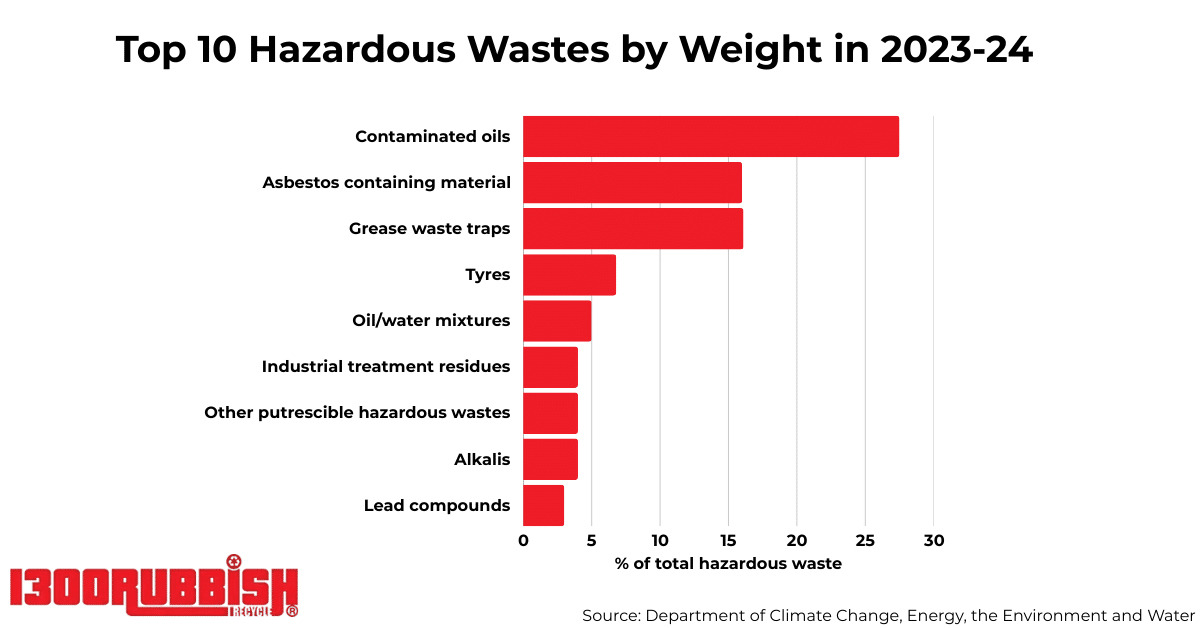
- The top 10 hazardous wastes generated by weight in 2023-24 were:
- Contaminated oils (28%)
- Asbestos containing material (16%)
- Grease trap wastes (16%)
- Tyres (7%)
- Oil/water mixtures (5%)
- Industrial treatment residues (4%)
- Other putrescible hazardous wastes (4%)
- Alkalis (4%)
- Lead compounds (3%)
E-waste
- Australia generates about 500,000 tonnes of e-waste each year. That’s about 20kg per person every year, compared to the global average of 7kg.
- The amount of waste is projected to rise to 657,000 tonnes by 2030. This is an increase of almost 30 per cent.
- In 2022, only about half of all e-waste was recycled.
- Only 35% of valuable materials were recovered.
Digging deeper into these specific statistics shows how much damage is caused by particular types of waste. Australia is consuming more plastic and failing to effectively recycle it.
Areas like e-waste also present a massive challenge to our national waste management approach as technology becomes even more ingrained in daily life. Significant changes will be required around the country to reduce the damage being done by these kinds of waste.
How Much Waste Does Each State Produce?
| State/Territory | Waste produced in 2022-23 (tonnes) | Waste produced in 2022-23 per capita (tonnes) |
| NSW | 27.5M | 3.34 |
| VIC | 16.1M | 2.39 |
| QLD | 15.3M | 2.83 |
| WA | 8.8M | 3.11 |
| SA | 5.2M | 2.86 |
| TAS | 1.1M | 1.93 |
| NT | 0.4M | 1.68 |
| ACT | 1.2M | 2.59 |
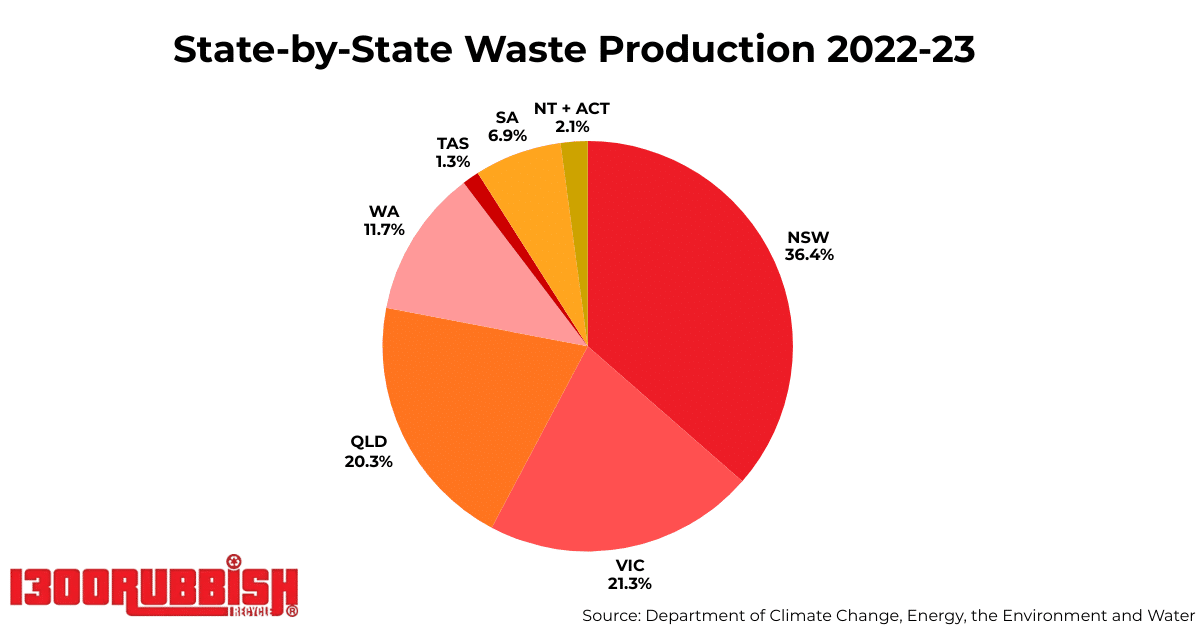
While areas like Tasmania and the NT have significantly lower waste production per capita, it’s important to note that these areas are quite reliant on the industry of states like NSW and WA. It doesn’t seem like any one state or territory has come up with a silver bullet solution to waste generation.
How is Waste Production Changing?
Between 2020-21 and 2022-23:
- Total waste generation increased by 0.9%.
- Waste generation per capita fell by 1.8%.
- The total amount of waste recycled and reused increased by 5.6%.
- Waste recycled and reused per capita has increased by 2.8%.
While these statistics show some positive trends, we need to make this progress significantly more rapid to avoid the worst environmental consequences of waste generation.
What Are the Consequences of Australia’s Waste Production?
Our failure to reduce consumption and dispose of waste in a more eco-friendly way has a range of damaging consequences. If changes are not made in the future, these issues will worsen.
Here are just some examples of the consequences of Australia’s massive waste generation:
- Food waste is responsible for approximately 3% of Australia’s greenhouse gas emissions.
- Landfills can also contaminate the surrounding environment, such as soil and water. This can also damage plants and animals living in these areas.
- It’s also estimated that plastic pollution kills 100,000 marine mammals every year.
- A growing area of interest concerns “forever chemicals” known as PFAS. These chemicals take thousands of years to break down and may have damaging effects on humans and animals when consumed. The significant growth of PFAS-contaminated waste presents major environmental challenges that could impact the planet for centuries to come.
- The increasing challenge of e-waste also presents serious consequences. E-waste is responsible for 70% of toxic chemicals found in landfill. In 2019, Australians sent $430 million worth of materials to landfill along with their e-waste. This failure in recycling means that there is a greater demand for mining these resources, which has its own environmental consequences.
Australia’s Goals For Reducing Waste
Australia has a collective action framework for reducing waste, laid out in the 2018 National Waste Policy. This policy has 7 key targets by which progress for waste reduction is measured.
Here are those targets, and how Australia is performing against them as of 2024:
| Target | 2024 Benchmarks |
| Ban on export of waste plastic, paper, glass and tyres, commencing in the second half of 2020. | All regulations and subordinate rules for these exports are in place. |
| Reduce total waste generated in Australia by 10% per person by 2030. | Since 2016–17, the amount of total waste generated has increased by 10kg per person, meaning we are far off-track for this target. |
| 80% average resource recovery rate from all waste streams following the waste hierarchy, by 2030. | Our resource recovery rate has increased by 5 percentage points since 2016–17. Certain waste streams are tracking well for this target, while others are hindering progress. |
| Significantly increase the use of recycled content by governments and industry. | The Federal, NSW, Victoria and WA governments have whole-of-government sustainable procurement policies in place. |
| Continued phase out of problematic and unnecessary plastics. | In 2023–24, an additional 7,000 tonnes of problematic plastics were placed on the national market when compared to 2020–21. |
| Halve the amount of organic waste sent to landfill for disposal by 2030. | Organic waste being sent to landfill has decreased by 5.7% since 2016–17. This progress will need to rapidly speed up to meet this target. |
| Make comprehensive, economy-wide and timely data publicly available. This will support better consumer, investment and policy decisions. | Resources in this area have significantly improved. |
How Does Australia Compare to Other Countries Around the World?
Here’s how Australia stacks up among a selection of countries for per capita municipal waste generation:
- Austria: 835.1kg
- United States: 811.5kg
- Denmark: 785.5kg
- Norway: 767.7kg
- Luxembourg: 720.8kg
- New Zealand: 702.8kg
- Switzerland: 677.2kg
- Iceland: 659.4kg
- Israel: 649.6kg
- Ireland: 645kg
- Finland: 630kg
- Germany: 593.1kg
- Czechia: 570.5kg
- Australia: 543.1kg
- France: 538.8kg
- Portugal: 510.3kg
- Greece: 509.2kg
- Netherlands: 472.8kg
- Spain: 468.1kg
- South Korea: 438.6kg
- United Kingdom: 436.3kg
- Turkey: 381.5kg
- Japan: 326.3kg
- Costa Rica: 309.9kg
Australia is significantly behind several European nations when it comes to waste production. However, there are plenty of other developed nations producing far less waste per capita, showing how much room for improvement we have in Australia.
Choose 1300 Rubbish For Ethical Waste Disposal
Want to do your bit to contribute to a more sustainable future? Choose 1300 Rubbish for a wide range of rubbish removal and disposal jobs. We tackle everything from basic household jobs to major construction projects.
We dispose of all waste responsibly and in line with government regulations, including recycling where appropriate. This includes our partnership with 1800 Ewaste, which means we recycle 95-98% of the e-waste we collect.
Choose 1300 Rubbish for ethical and responsible waste management. Get in touch online or 1300 782 247 to get a free estimate on any rubbish removal job.
<Get your free estimate>
Frequently Asked Questions
What is Australia’s Recycling Rate For Plastics?
In 2022-23, Australia’s resource recovery rate for plastics was 12%, the lowest out of any category analysed by the Department of Climate Change, Energy, the Environment and Water.
Which Country is the Largest Producer of Waste Globally?
As of 2022, the United States was the largest producer of municipal waste. The US produces over 200 million tonnes of municipal waste each year.
How Much Waste Goes Into Landfill Every Year in Australia?
Australia sends over 20 million tonnes of waste to landfill each year.
How Much Waste Does Australia Produce Per Year?
In the 2022-23 financial year, Australia generated an estimated 75.6 million tonnes (Mt) of waste.
References
www.abc.net.au/news/2025-02-10/business-ewaste-recycling-reuse-microsoft-windows-10/104909752
www.abs.gov.au/statistics/environment/environmental-accounts/waste-account-australia-experimental-estimates/latest-release
/www.abs.gov.au/statistics/measuring-what-matters/measuring-what-matters-themes-and-indicators/sustainable/circular-economy
www.cleanup.org.au/e-waste
https://www.dcceew.gov.au/about/news/updated-national-waste-resource-recovery-reporting
www.dcceew.gov.au/environment/protection/waste/publications/national-waste-resource-recovery-reporting/glance-2024
www.dcceew.gov.au/environment/protection/waste/plastics-and-packaging/australian-plastic-flows-fates-reporting
www.dcceew.gov.au/environment/protection/waste/food-waste
www.dcceew.gov.au/sites/default/files/documents/hazardous-waste-australia-2025.pdf
www.dcceew.gov.au/environment/protection/waste/publications/national-waste-policy-action-plan
www.dcceew.gov.au/environment/protection/waste/publications/national-waste-resource-recovery-reporting/resource-recovery-waste-material-analysis-2024
www.statista.com/statistics/1336513/global-generation-of-municipal-solid-waste-per-capita-by-country
www.statista.com/statistics/916749/global-generation-of-municipal-solid-waste-by-country
www.unsw.edu.au/newsroom/news/2023/03/trying-to-solve-the–forever-problem–of-pfas-pollution
www.wwf.org.au/blogs/plastic-in-our-oceans-is-killing-marine-mammals